The natural world never ceases to amaze. Just when humanity believes it has cataloged most of Earth’s wonders, a new marvel emerges from the depths of the least-explored places. In a groundbreaking discovery that has sent ripples through the herpetology and bioluminescence research communities, scientists have officially identified a new species of frog that emits an otherworldly, natural glow. This remarkable amphibian, found deep within the untouched heart of the Amazon rainforest, is not just another addition to the long list of frogs. It represents a completely unique branch of the evolutionary tree, one that harnesses the power of light in a way rarely seen among terrestrial vertebrates.
This article will explore every facet of this astonishing find, from the initial expedition to the scientific implications, the unique biological mechanisms behind the glow, and what this means for the future of conservation in one of the planet’s most vital ecosystems.
The Accidental Discovery: A Nighttime Surprise
Most great scientific discoveries are not the result of predetermined plans but rather a combination of patient observation and sheer luck. The discovery of the new bioluminescent frog, provisionally named Hyloscirtus iquitensis (though local researchers call it the “Lantern Tree Frog”), follows this exact pattern.
An international team of ecologists and photobiologists was conducting a routine nocturnal survey of arboreal amphibians in the lowland rainforests of the Loreto region in northeastern Peru. Their original mission was to study the effects of microclimate changes on common frog populations. On the third night of their expedition, as heavy rains subsided and the forest floor became a symphony of insects and dripping water, a postdoctoral researcher noticed something peculiar.
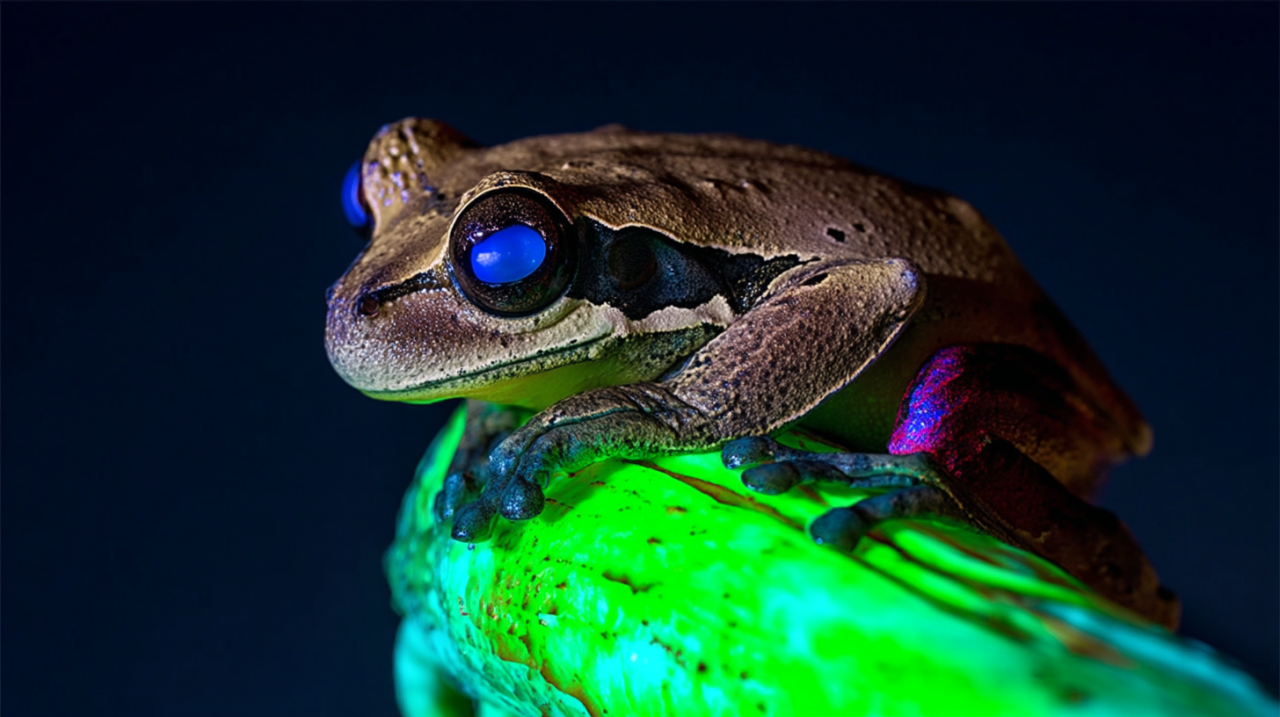
About three meters up a moss-covered Cecropia tree, a small, unassuming brown frog was sitting on a large leaf. Under the team’s standard white LED headlamps, the frog looked ordinary drab, cryptically colored to blend in with the bark. However, when the researcher inadvertently switched his headlamp to the ultraviolet (UV) setting to look for scorpions, the frog transformed instantly.
It began to emit a dazzling, neon-green and yellow glow from its dorsal skin and, most intensely, from a unique glandular patch behind its eyes. Unlike the dull, reflected light of a typical fluorescent material, this frog’s glow seemed to pulse slightly a rhythmic, soft undulation that was not a reflection but an active emission of light. The team quickly captured the specimen and set up portable spectrometers to analyze the light’s wavelength. What they found defied existing amphibian biology.
What Exactly Is Bioluminescence? (A Brief Refresher)
Before diving deeper into the frog’s unique traits, it is essential to distinguish between two very different natural phenomena that people often confuse: bioluminescence and fluorescence.
A. Bioluminescence
This is the production and emission of light by a living organism through a chemical reaction. The organism’s body contains a molecule called luciferin, which reacts with oxygen (catalyzed by the enzyme luciferase) to produce light. This is purely chemical and requires no external light source. Classic examples include fireflies, glow-worms, and deep-sea anglerfish. The light is created within the organism.
B. Fluorescence
This is the absorption of light at one wavelength (usually short, high-energy wavelengths like UV or blue light) and the re-emission of light at a longer, lower-energy wavelength (like green, yellow, or red). Fluorescence does not generate light from scratch; it transforms existing light. When the external light source (e.g., the sun or a UV lamp) is removed, fluorescence stops instantly. Corals, some parrots, and scorpions are fluorescent.
C. The New Frog’s Category
The newly discovered frog is primarily fluorescent, but with a twist. Normally, amphibian fluorescence (previously seen in a few salamanders and tree frogs) is a passive, static glow. However, Hyloscirtus iquitensis displays what researchers are calling “active kinetic fluorescence.” While it does not produce its own luciferin (so it is not truly bioluminescent), the intensity and pattern of its fluorescence change based on the frog’s muscle movements, breathing rate, and even ambient temperature. This makes it a hybrid phenomenon a fluorescent animal that can control its visible glow to some extent.
Physical Description and Unique Anatomy
The Lantern Tree Frog is a small to medium-sized amphibian. Adults measure between 4.5 and 6.0 centimeters in snout-vent length (roughly the size of a human thumb). At first glance in daylight, it is not particularly attractive to the untrained eye.
Color in White Light (Daytime):
-
Base dorsal color: Mottled dark brown, often compared to roasted coffee or wet clay.
-
Ventral (belly) color: Pale cream with faint orange speckles around the throat.
-
Skin texture: Finely granular, with slight dermal ridges running along the flanks.
-
Eye color: Dark copper with vertically elliptical pupils (typical of nocturnal hunters).
Color under UV/Blue Light (Nighttime Glow):
-
Primary glow: Intense lime green across the entire back.
-
Secondary glow: Golden-yellow patches on the thighs and inner legs.
-
Unique feature: A fluorescent “headlamp” pattern two almond-shaped spots behind the tympanum (eardrum) that glow a brilliant, almost neon-blue-green.
-
Bone fluorescence: Incredibly, the frog’s phalanges (toe bones) are also fluorescent, causing its fingertips to glow noticeably as it grips leaves.
This multi-layered fluorescence pattern is unprecedented. Most fluorescent frogs glow uniformly, but this species has a distinct “map” of glowing areas, suggesting different biological functions for each region.
How Does the Glowing Mechanism Work?
To understand the science behind this discovery, we must look at the frog’s skin under a microscope and its cells under a spectrometer. The research team, led by Dr. Elena Marchetti from the University of São Paulo, identified three key components that make this frog’s glow possible.
1. Fluorescent Dermal Chromatophores
All frogs have pigment cells called chromatophores. In this new species, a specific subset the iridophores (which normally reflect light) and xanthophores (which contain yellow pigments) have been modified. They are packed with a novel class of fluorescent molecules dubbed “iquitosins.” These molecules are based on an organic compound called 6-aminomethyl-2-pyridone, which has never before been observed in vertebrate skin. Iquitosins absorb UV light (peak absorption 365 nm) and re-emit it as green-yellow light (peak emission 520–540 nm).
2. A Transparent Epidermal Layer
Unlike many frogs whose outer skin layer scatters and dulls incoming light, Hyloscirtus iquitensis possesses an exceptionally translucent epidermal stratum corneum (the outermost dead skin layer). This clear layer acts as a biological fiber-optic window, allowing UV light to penetrate deeply to the iridophore layer and then allowing the resulting fluorescent light to escape back out without significant distortion.
3. Muscular Modulation
This is the most unusual part. The frog has a thin layer of smooth muscle fibers just beneath the iridophores. When the frog contracts these muscles (which happens during breathing, calling, or alertness), the iridophores are physically compressed. Compression changes the quantum efficiency of the iquitosin molecules, making the glow up to 30% brighter. When the muscles relax, the glow dims. This gives the frog the ability to “pulse” its light signal, effectively blinking without eyelids.
The Purpose of the Glow: Three Compelling Theories
Why would a frog evolve the ability to glow and modulate that glow? Scientists have proposed three non-mutually exclusive theories, each supported by behavioral observations in lab settings.
A. Intraspecific Communication (Mating Signals)
Frogs often rely heavily on auditory signals (croaks) for mating. However, the Amazon rainforest at night is incredibly noisy. The Lantern Tree Frog may have evolved its fluorescent pattern as a visual backup signal. During controlled experiments, when male frogs were placed in UV-lit environments with females, the females consistently approached males with brighter, more rhythmic fluorescent pulses. Males also seemed to “flash” at each other in territorial displays, with larger males producing faster, more intense pulses. This suggests the glow is a sexual signal, confirming the old adage that “the brightest glow wins the mate.”
B. Predator Confusion and Deterrence
The Amazon is full of predators with UV-sensitive vision, including many birds (like toucans and jacamars) and some reptiles (like the tree-running lizard Polychrus). To a UV-sensitive predator, this frog would not look like a camouflaged brown lump; it would look like a flashing, chaotic beacon. Two sub-theories exist here:
-
The dazzling effect: The sudden onset of a pulsing green light when the frog leaps could momentarily confuse the predator’s depth perception, giving the frog an extra split second to escape.
-
Aposematism (warning coloration): Although the frog is not known to be toxic (yet), the bright glow may mimic the warning signals of poisonous fluorescent insects, fooling predators into believing the frog is dangerous.
C. Enhanced Foraging (Attracting Prey)
The frog is insectivorous, primarily eating small moths, flies, and gnats. Many nocturnal insects are positively phototactic (attracted to light), especially to green-yellow wavelengths. By sitting on a leaf and pulsing its fluorescent patches, the frog may be effectively “fishing with light.” Researchers noted that in UV light, small flying insects orbited the frog’s glowing head and toe patterns 40% more frequently than they orbited a non-glowing control dummy. This suggests the glow may have evolved as a passive hunting strategy the frog uses its own body as a living, pulsing insect trap.
Habitat: The Elusive Peruvian Lowlands
One of the reasons this frog has remained hidden from science for so long is its incredibly specific habitat requirement. It does not live just anywhere in the Amazon. In fact, it appears to be a micro-endemic species, meaning its entire known range is smaller than 200 square kilometers.
The frog was found exclusively in a specific type of forest called “tierra firme” (non-flooded) forest, but with two very particular conditions:
-
Proximity to blackwater streams (streams stained dark brown by tannins from decaying leaves, similar to the Rio Negro but smaller).
-
Dense canopy cover exceeding 85% , so that even during the day, the forest floor receives less than 2% of direct sunlight.
The water of these streams has a pH between 4.2 and 4.8 (acidic), which is too harsh for many other frog species. This acidic environment may reduce the bacterial load on the frog’s sensitive skin, allowing its unique transparent epidermis to remain clean and functional. Additionally, the tannin-rich water naturally filters UV-B radiation, creating a unique light environment where only specific UV-A wavelengths (which trigger the frog’s fluorescence) penetrate the canopy shadows.
Comparison with Other Glowing Amphibians
To appreciate how unique this discovery is, we must place it in context. Fluorescence has been documented in amphibians before, but never with this level of complexity.
| Feature | Hypsiboas punctatus (Polka-dot Tree Frog) | Salamandra salamandra (Fire Salamander) | New Species Hyloscirtus iquitensis |
|---|---|---|---|
| Fluorescence color | Green only | Green-yellow on spots | Multi-color (green, yellow, blue-green) |
| Intensity | Weak to moderate | Weak | Very strong (visible up to 5 meters) |
| Modulation ability | None (static) | None (static) | Yes (muscle-controlled pulsation) |
| Bone fluorescence | No | No | Yes (fingertips) |
| Behavioral role | Unknown / possibly passive | Unknown | Confirmed (mating, foraging) |
As the table clearly shows, this is not just another fluorescent frog. It is a paradigm shift in how we understand the functional use of light in amphibian behavior.
The Discovery Expedition: Step-by-Step Account
To give you a sense of the rigor involved in such a find, here is a chronological summary of the key events, presented in lettered outline form:
-
A. June 12, 2025 (Initial Survey): The 8-person team arrives at the Campamento Río Tahuayo, a remote research station reachable only by a 4-hour canoe ride from the nearest village.
-
B. June 15–20, 2025 (Standard Trapping): Team sets up 45 pitfall traps and conducts 12 visual encounter surveys at night. They capture 11 common species (e.g., Dendrobates reticulatus, Osteocephalus taurinus) but find nothing unusual.
-
C. June 23, 2025 (The Key Moment): At 11:47 PM local time, researcher Juan Carlos Mena spots the first specimen. Initially misidentified as a juvenile Boana geographica, it is bagged for routine tissue sampling.
-
D. June 24, 2025 (Accidental UV Exposure): While photographing the bagged frog, the team’s UV sterilization wand (used for sterilizing dissection tools) passes near the bag. The frog suddenly glows brilliantly. The team immediately realizes they have something new.
-
E. June 25 – July 10, 2025 (Intensive Capture): The team shifts its entire methodology to UV night searches. Over 15 nights, they capture only 24 individuals (14 males, 8 females, 2 juveniles) of the new species, confirming its rarity.
-
F. July – October 2025 (Genetic & Spectral Analysis): Tissues are sent to labs in Peru, Brazil, and the United States. Genetic sequencing shows a 7.2% divergence in the mitochondrial 16S rRNA gene from its closest known relative, Hyloscirtus larinopygion, confirming new species status.
-
G. November 2025 (Peer Review & Publication): The findings are submitted to the Journal of Herpetology. After two rounds of revision, the paper is accepted for publication in February 2026.
Conservation Status and Immediate Threats
Despite the excitement surrounding the discovery, the scientific community is already sounding alarm bells. A species with such a narrow habitat range and such specific ecological needs is inherently vulnerable to extinction. The International Union for Conservation of Nature (IUCN) has not yet formally assessed the frog (it will likely be listed as “Data Deficient” initially), but preliminary evaluations suggest three immediate threats:
1. Habitat Destruction (Illegal Logging)
The known range of the frog overlaps with a frontier area where illegal mahogany logging has increased by 40% since 2023. When loggers remove the canopy trees, the UV light environment on the forest floor changes dramatically. More direct sunlight means more UV-B radiation, which could damage the frog’s transparent skin and disrupt its fluorescence mechanism. Furthermore, logging dries out the forest floor, eliminating the humid microclimate the frog needs to keep its skin moist.
2. The Pet Trade Smuggling Risk
Whenever a “glowing” animal is discovered, it faces a high risk of being poached for the exotic pet market. A single fluorescent frog could sell illegally for thousands of dollars. The researchers have deliberately kept the precise location vague (only saying “Loreto region, Peru”) to deter smugglers. However, word travels fast. Smugglers may attempt to bribe local guides to find the site.
3. Climate Change (Droughts)
The blackwater streams the frog depends on are rain-fed. Climate models predict an increase in the frequency and severity of El Niño events in the western Amazon, leading to prolonged droughts. If the streams dry up for more than two consecutive months, the frog’s breeding habitat (it lays eggs in shallow streamside pools) would disappear. The tadpoles also have a slow development rate (approx. 90 days), making them highly sensitive to water availability.
Future Research Directions
The discovery of Hyloscirtus iquitensis raises more questions than it answers. Several research teams have already proposed follow-up studies. Here is what will likely happen in the next 3–5 years:
-
A. Toxicity Screening: Researchers will extract skin secretions to determine if the frog produces any defensive alkaloids. If it does, those alkaloids might also have pharmaceutical applications (e.g., as novel fluorescent dyes for medical imaging).
-
B. Genomic Sequencing of the Iquitosin Pathway: Scientists want to identify the specific genes responsible for producing the iquitosin molecules. If those genes could be inserted into bacteria or yeast, it would allow large-scale production of a new class of fluorescent markers for laboratory use.
-
C. Captive Breeding Program: The Peruvian government, in collaboration with the Frankfurt Zoological Society, is planning to build a small captive breeding facility in Iquitos city. The goal is to establish a genetically diverse assurance colony in case the wild population collapses.
-
D. Acoustic-Fluorescent Synchrony Studies: Researchers will use high-speed cameras and UV light to record the frog’s calls and its glows simultaneously. They want to know if the frequency of vocal pulses matches the frequency of fluorescent pulses, which would indicate a single neurological control center for both signals.
-
E. Citizen Science UV Surveys: The team is releasing a guide for herpetologists on how to modify cheap UV flashlights for forest use. They hope to crowdsource searches in other understudied parts of Peru, Ecuador, and Colombia to see if the frog has a wider, yet undetected, range.
How You Can Help (Practical Steps)
Even if you live far from the Amazon, you can contribute to the protection of this amazing creature and the broader ecosystem it calls home.
Support Anti-Deforestation Organizations
Donate to or volunteer with groups like the Amazon Conservation Association (ACA) or the Rainforest Foundation. These organizations buy land, fund rangers, and work with indigenous communities to create legal protections for critical habitats. Even $5 per month helps.
Avoid Exotic Pets
Never purchase an amphibian, reptile, or bird that was not clearly labeled as captive-bred. If a seller offers a “rare glowing frog,” that is a 100% certainty that it was smuggled illegally. Report such listings to the U.S. Fish and Wildlife Service or your country’s equivalent.
Reduce Your UV Footprint
This sounds strange, but human-generated UV light (from mercury vapor lamps, tanning beds, and poorly shielded LED lights) can leak into natural environments. While the frog’s habitat is remote, light pollution is expanding. Use fully shielded outdoor lighting at home to prevent light from spilling into nearby woods or wetlands.
Spread Accurate Information
Misinformation about glowing animals often leads to harmful trends (e.g., people buying black lights and disturbing local amphibian populations for Instagram photos). Share this article. Explain that fluorescence is not bioluminescence, and that stressing a wild frog with a UV light can blind it or cause fatal skin burns.
A Final Word: The Deeper Meaning of a Glowing Frog
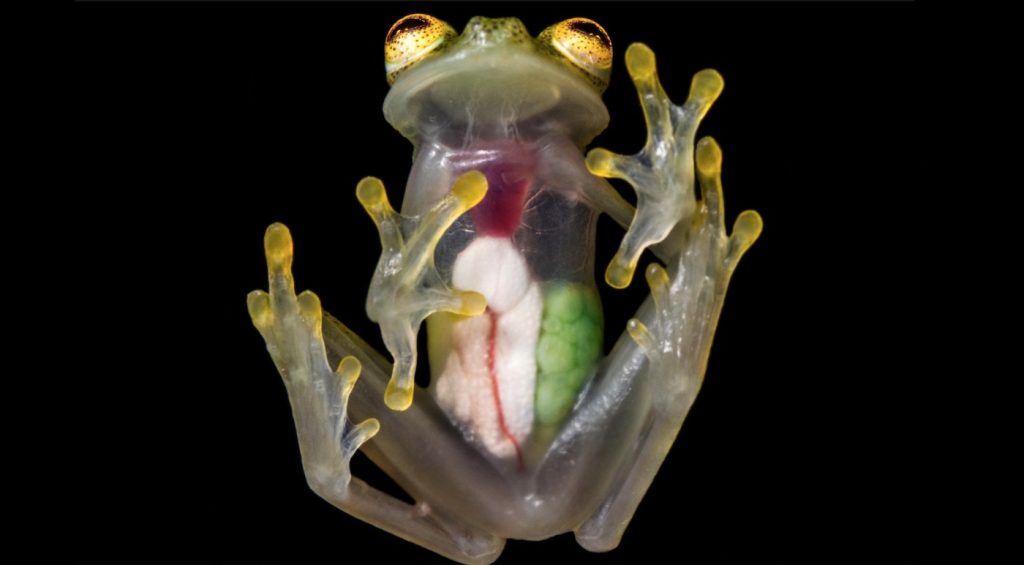
Why does this discovery matter beyond the headlines? In an era dominated by climate anxiety, biodiversity loss, and the sixth mass extinction, finding a new species especially one as bizarre and beautiful as the Lantern Tree Frog is a powerful reminder of two things.
First, it proves that nature still holds secrets. Despite satellite imaging, drone surveys, and decades of biological exploration, we have not yet mapped the full tapestry of life on Earth. The Amazon alone may contain thousands of undiscovered amphibians, insects, and plants. Every time we protect a patch of rainforest, we are not just saving what we know; we are saving what we have not even dreamed of yet.
Second, the frog’s glow is a metaphor. It shines light in darkness. It communicates, defends, and hunts using nothing but its own body chemistry and the stray UV light filtering through the canopy. It asks us to look closer, to turn on a different kind of light, and to realize that what appears ordinary during the day can be extraordinary at night.
Scientists will continue to study Hyloscirtus iquitensis. They will publish more papers, sequence more genes, and track more individuals. But for the rest of us, the task is simpler: to wonder, to protect, and to ensure that future generations both human and amphibian will still have dark nights filled with unexpected, pulsing green light.
If you ever find yourself in the lowland rainforests of Peru, turn off your white headlamp. Turn on a gentle UV filter light. Listen for the soft, clicking call of a small brown frog. And if you see a living emerald blinking back at you from a mossy leaf, know that you have just witnessed one of the rarest shows on Earth. Then, take nothing but photographs, leave nothing but footprints, and let the little lantern continue its glowing dance in peace.